
The SAVE Act
A Trojan Horse for Election Integrity?

Authors Note: Civic duty is not fulfilled by slogans or symbols, but by the quiet rigor of due diligence—the deliberate act of seeking truth, weighing consequence, and refusing the comfort of ignorance. It lives in the hours spent questioning authority, examining facts, and tending the fragile boundary between liberty and neglect. In this way, citizenship becomes less a title bestowed and more a discipline chosen, renewed each time conscience is placed above convenience.
This is the quiet path by which I set these words before you, inviting your eyes to see where my observations have gone.
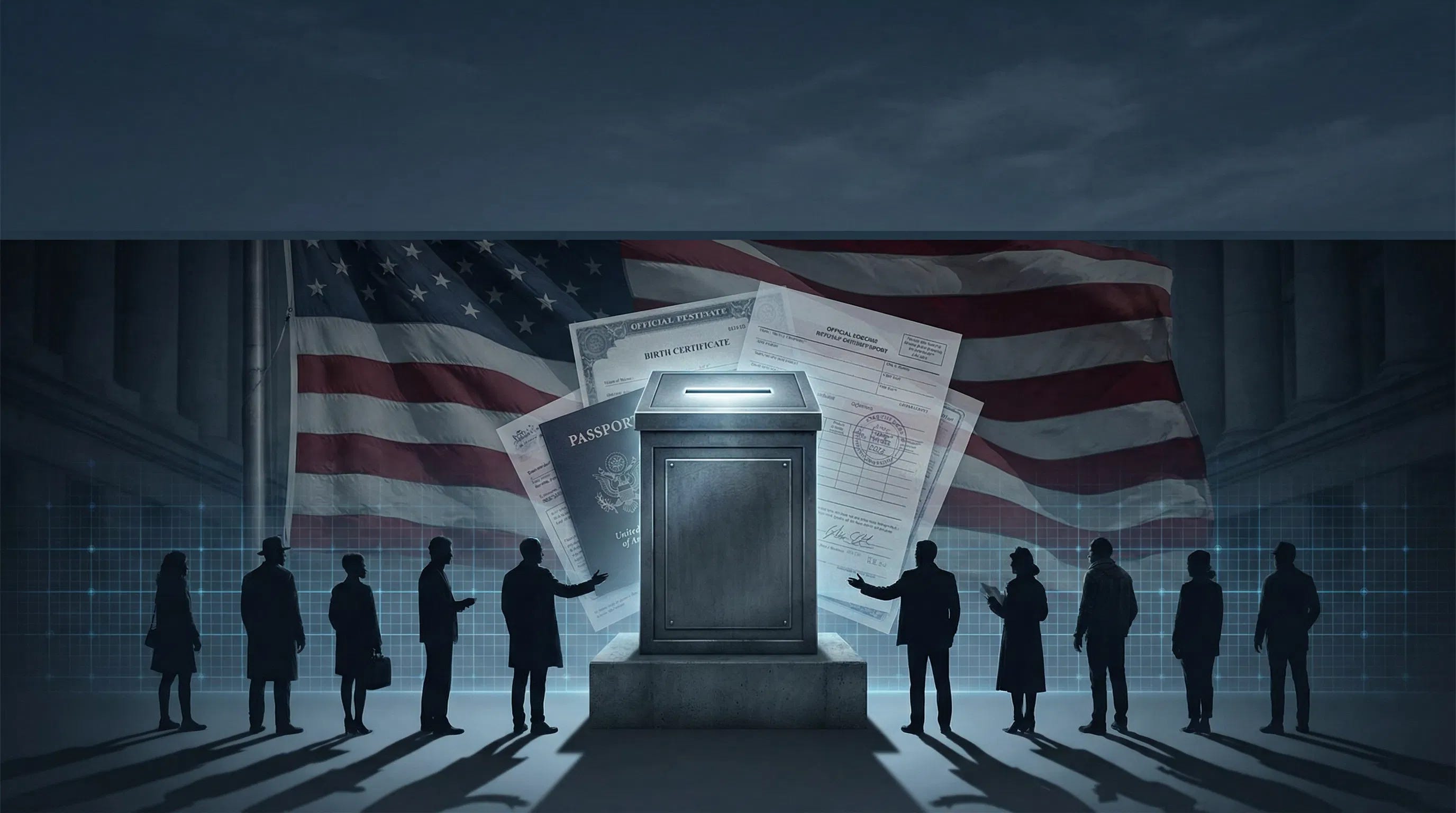
In the ever-contentious arena of American elections, a new legislative titan has entered the ring. H.R. 22, the “Safeguard American Voter Eligibility Act” or SAVE Act, passed the House of Representatives on April 10, 2025, and now awaits its fate in the Senate. On its face, the bill presents a simple, almost unassailable proposition: only U.S. citizens should vote in U.S. elections. To achieve this, it seeks to amend the National Voter Registration Act of 1993 (NVRA), replacing a system of sworn attestation with a mandate for documentary proof of citizenship at the time of registration.
Proponents herald it as a common-sense measure to secure the ballot box. Opponents decry it as the most significant act of voter suppression in a generation. But a deeper analysis, one that goes beyond the talking points and into the bill’s mechanical core, reveals a far more complex and potentially transformative piece of legislation. The SAVE Act is not merely about who can vote; it is about fundamentally re-engineering the relationship between the citizen, the state, and the federal government, with profound implications for both election administration and civil liberties.
This article will dissect the SAVE Act, moving beyond the surface-level debate to explore the critical analysis of researchers like Capt. Seth Keshel, who offers a more nuanced view of the bill’s strategic importance.

We will examine beyond the paywall,1 the why, where, when, how, and—most importantly—what to do about it, so that you, the reader, are equipped not just to understand, but to act.
Under the Hood: The Mechanics of the SAVE Act
The SAVE Act is not a minor tweak to election law; it is a systemic overhaul of the voter registration process established by the 1993 National Voter Registration Act (NVRA), commonly known as the “Motor Voter” law. The NVRA was designed to increase voter registration by allowing citizens to register at DMVs and other government agencies by simply attesting to their citizenship under penalty of perjury. The SAVE Act effectively repeals this 30-year-old framework and replaces it with a system of mandatory, upfront verification.
The core provisions of the bill represent a multi-pronged approach to enforcing citizenship requirements, creating new mandates for states, federal agencies, and election officials alike.
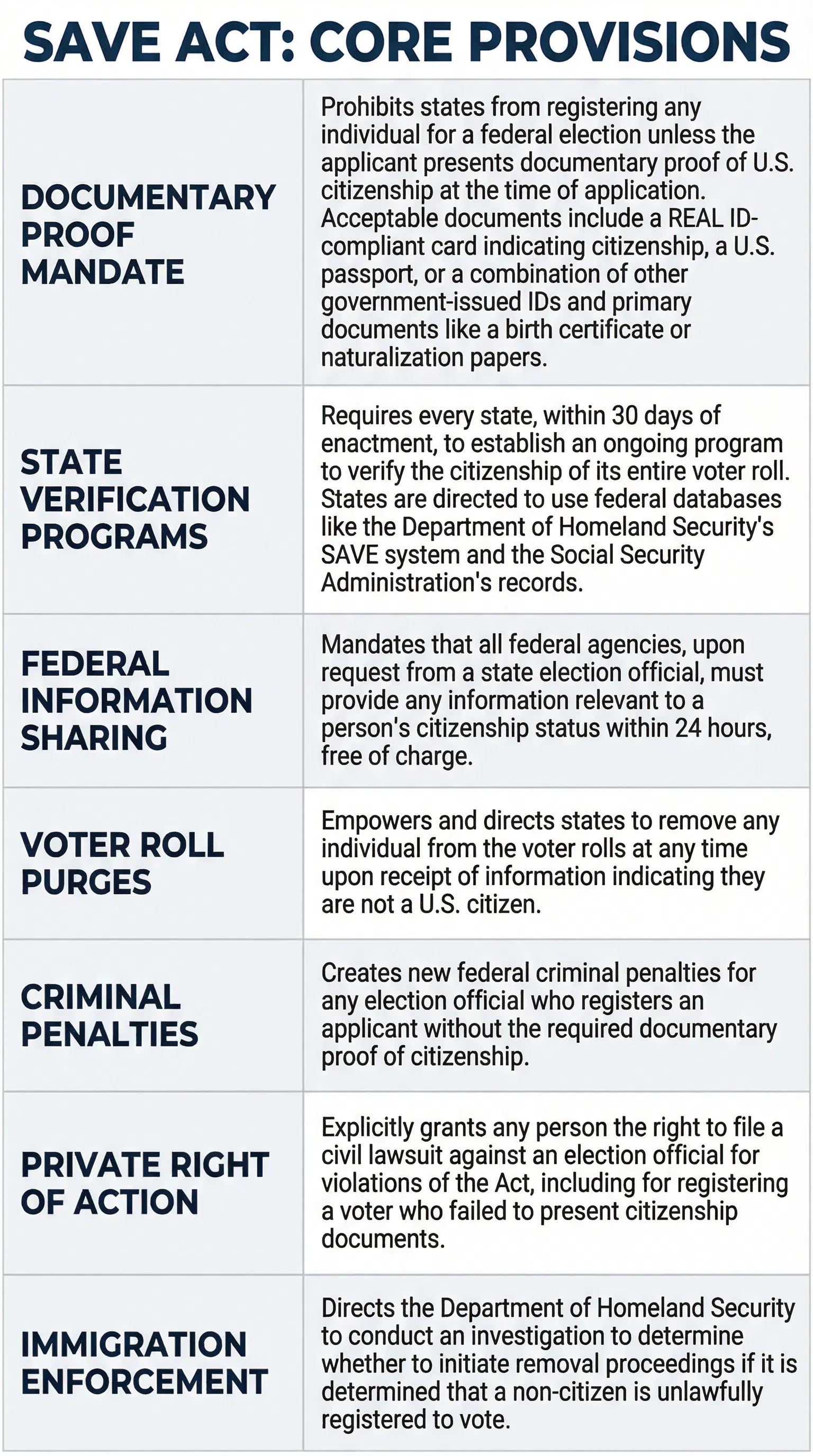
These mechanisms work in concert to transform voter registration from a state-managed civic process into a federally supervised, security-oriented system inextricably linked to immigration enforcement.
The Two Debates: A Problem of Non-Citizen Voting, or a Ploy for Voter Suppression?
The public debate over the SAVE Act is split into two irreconcilable narratives.
On one side, proponents argue the bill is a necessary safeguard against a clear and present danger. They contend that lax registration laws, particularly the “motor voter” system, have allowed an unknown number of non-citizens onto the voter rolls, creating a vulnerability that undermines the integrity of American democracy. The logic is straightforward: if citizenship is a prerequisite for voting, then proving it should be a prerequisite for registering.
On the other side, a coalition of civil rights groups, including the ACLU and the Brennan Center for Justice, argues the SAVE Act is a “solution in search of a problem.” They point to evidence that non-citizen voting is vanishingly rare. A 2025 review by the Michigan Department of State, for example, found just 15 credible cases of non-citizens casting a ballot out of more than 5.7 million votes—a rate of 0.00028%. Instead of securing elections, they argue, the bill’s true effect would be to disenfranchise millions of eligible American citizens who lack ready access to their citizenship documents. A 2023 survey by the Brennan Center found that over 21 million voting-age citizens do not have their citizenship documents readily available, with disproportionate impacts on voters of color, the elderly, and low-income Americans.
Beyond the Obvious: Capt. Keshel Three-Pronged Attack
While the public debate remains locked in this binary, a more sophisticated analysis comes from retired Army Captain and election researcher Seth Keshel. Initially skeptical of the SAVE Act’s importance, Keshel has since identified it as a potential game-changer, but not for the reason most people think.
Keshel’s crucial insight is to distinguish between non-citizens voting and non-citizens being voted for. He posits that the primary threat is not waves of non-citizens showing up to the polls, but rather the mass registration of ineligible individuals whose names are then used to cast fraudulent ballots, likely through mail-in systems. In this view, bloated voter rolls are not just a sign of administrative sloppiness; they are a strategic resource for election fraud.
This is where the SAVE Act’s true power, and the reason for Keshel’s optimism, becomes clear. The bill’s most significant impact may not be on individual voters at the polling place, but on the automated, large-scale registration systems that have become prevalent in recent years. Chief among these is Automatic Voter Registration (AVR).
Implemented in 25 states and D.C., AVR systems automatically register individuals to vote during transactions with government agencies, most commonly the DMV.
Although his complete analysis is behind a paywall—which is understandable given the realities of professional writing in the current economic environment—his publicly stated first point, when combined with a textual analysis of the bill, allows for a reasoned reconstruction of the three-pronged strategy he references for dismantling these alleged “registration scams.” What follows are two informed hypotheses regarding Keshel’s proposed methods by which the SAVE Act addresses such practices.
Neutralizing Third-Party Registration Drives (Speculative)
Following Keshel’s logic, the second target must be the other major source of high-volume, low-verification registrations: third-party voter registration drives. These efforts, often run by partisan or non-profit groups, are a cornerstone of modern field campaigns. They collect thousands of paper registration forms at public events, on college campuses, and in targeted communities.
The SAVE Act neutralizes this model by severing the link between filling out the form and becoming a registered voter. Section 2(d) of the Act mandates that even if a voter registers by mail (or via a form collected by a third party), they must still appear in person before an election official to present their citizenship documents. This transforms a simple, one-step process into a multi-step ordeal for the voter, destroying the efficiency and scalability of registration drives. No longer can a group simply collect and submit forms en masse; they now must convince each individual to make a separate trip to a government office. This logistical nightmare effectively guts the operational model of these drives.
Forcing Aggressive and Continuous Voter Roll Purges (Speculative)
The third prong of the strategy moves from preventing new invalid registrations to actively removing existing ones. The SAVE Act creates a powerful and relentless enforcement engine that forces states to clean their voter rolls, overriding the political reluctance of officials who may benefit from inflated lists.
This is achieved through two key provisions:
Mandatory State Verification Programs: Section 8(j) of the Act is not a suggestion; it is a command. Within 30 days, every state must establish an ongoing program to verify its entire voter roll against federal DHS and Social Security databases. This creates a permanent, automated audit function.
The Private Right of Action: Perhaps the most potent weapon in the bill is Section 2(i), which empowers any person to file a civil lawsuit against an election official for failing to comply with the Act. This effectively deputizes citizens and activist legal groups to act as enforcement agents. If a Secretary of State refuses to aggressively purge their rolls based on the data from federal databases, they will be immediately sued. This creates a legal vise that forces compliance, regardless of an official’s political agenda.
Together, these three mechanisms form a comprehensive strategy. The first two prongs shut down the primary methods of mass-registering unverified individuals (automated/online and third-party drives), while the third prong creates a powerful, legally-enforceable machine to continuously purge existing rolls of ineligible names. This is the “one-two-three punch” that likely informs Keshel’s optimism about the bill’s potential to fundamentally alter the landscape of American voter registration.
The Weaponization of Bureaucracy
Viewed through this strategic lens, the SAVE Act is more than a voter ID law on steroids; it is a piece of bureaucratic warfare. It erects a federal firewall against the automated expansion of state voter rolls and, for the first time, creates a direct, mandatory link between state voter registration data and federal immigration databases.
The provision requiring DHS to investigate registered non-citizens for removal proceedings is particularly telling. It transforms the act of voter registration into a high-stakes immigration checkpoint. The threat of deportation, whether real or perceived, would undoubtedly have a chilling effect, not only on non-citizens but also on eligible, naturalized citizens and their families who may fear that a bureaucratic error could have life-altering consequences.
Furthermore, the imposition of criminal penalties on local election officials for registering someone without proper documentation creates a culture of risk aversion. When faced with a complex case or ambiguous documentation, the safest course of action for an official will be to deny registration. This shifts the institutional bias from inclusion to exclusion.
What To Do About It: An Action Plan for the Engaged Citizen
The SAVE Act forces a confrontation with fundamental questions about our republic. Do we prioritize security over access, or access over security? Is the risk of non-citizen voting greater than the risk of disenfranchising eligible citizens? The bill’s framework suggests a choice has been made. For those who believe this is the wrong choice, passive disagreement is not an option. The bill is designed to be implemented swiftly and decisively. Action must be equally swift and decisive.
Educate and Disseminate: The most powerful tool is understanding. The mainstream narrative has failed to grasp the strategic implications of this bill. Share this analysis and the primary sources. Explain to your friends, family, and community that this is not just about showing an ID; it is about a fundamental restructuring of our election systems and their connection to federal power.
Contact Your Senators Immediately: The bill has passed the House. The Senate is now the sole firewall. Call, email, and write to your two U.S. Senators. Do not use a form letter. In your own words, explain your opposition. Tell them you are a constituent, you are watching this vote, and you oppose H.R. 22 because it will disenfranchise eligible voters and represents a federal overreach into state election authority.
Engage at the State Level: Contact your state legislators and your Secretary of State. Ask them what preparations they are making for the potential passage of the SAVE Act. Voice your concern about the administrative burdens, the costs to the state, and the potential for mass disenfranchisement. Urge them to publicly oppose this federal mandate.
Support Election Integrity and Civil Liberties Groups: Organizations on both sides of this issue are mobilizing. Support those that align with your principles. Groups focused on civil liberties and voter access will be critical in challenging this law in court if it passes. Groups focused on election integrity can be pressured to advocate for solutions that do not come at the expense of eligible voters.
Prepare for Legal and Civic Action: If the SAVE Act becomes law, the fight will move to the courts and the states. Be prepared to support legal challenges and to participate in state-level efforts to mitigate the damage. This includes monitoring your own voter registration status and helping others in your community do the same.
The SAVE Act is a legislative earthquake. Its passage would send shockwaves through the foundation of our electoral process. Its significance cannot be overstated. The time for passive observation is over. The time to act is now.
De Jure Media affirms the rigor of citizen journalism and encourages subscription-based support. Nevertheless, we consider this message of sufficient public importance to remain outside a paywall.
What? Disenfranchise? The American Registered Voters Have Already Been Disenfranchised! I have seen little to zero legislation in-the past 50 years that could not be twisted and used against Bill of Rights working paycheck to paycheck voting citizens. The SAVE Act is head and shoulders above the wrist slapping Witnessed since 2020.
Thank Your Senators
The Senate has kept the SAVE Act stalled for nearly 300 days—and that's exactly where it should stay.
This bill would force millions of eligible Americans to jump through new bureaucratic hoops to vote, threaten election officials with prison for registering legitimate voters, and violate the constitutional principle that states set voter qualifications. Meanwhile, state audits of the 2024 election found noncitizen voting is extraordinarily rare—16 cases out of 5.7 million votes in Michigan, 35 out of 1.6 million in Iowa.
Thank your Senators for protecting voting rights. Text SIGN POLYTJ to 50409 or visit https://resist.bot/petitions/POLYTJ