
Vanguard's Surrender
How Texans Answered 'They or We'


Years ago, we posed a fundamental question: They or We?
Do unelected, unaccountable institutions dictate the course of American life, or do the people and their elected representatives? For decades, the answer has been increasingly clear: a creeping, centralized power, what we identified as “They,” has sought to impose its will. Nowhere has this been more apparent than in the financial sector, where a handful of asset managers, operating like a “Fourth Branch of government,” have wielded immense power far from public view.
February 26, 2026 that question was answered in Texas. And the answer is: We.
The agreement reached between The Vanguard Group and a coalition of 13 state attorneys general, led by Texas AG Ken Paxton, is not a mere settlement. It is a surrender.
It marks a historic reversal in the quiet war that has been waged over the sovereign authority of states to set their own energy policies. On one side, a powerful cartel of asset managers—BlackRock, State Street, and Vanguard—sought to impose a radical climate agenda under the guise of Environmental, Social, and Governance (ESG) investing. On the other, the elected representatives of the people.
Their strategy was as simple as it was audacious: use their immense voting power as shareholders to force companies to constrict the supply of fossil fuels, drive up energy costs, and accelerate a transition to “green energy,” regardless of the economic consequences or the will of the voters. It was a direct assault on the principles of federalism and free-market competition. As we’ve explored in “State Sovereignty vs. Corporate ‘Speech’,” this represents an even more insidious form of corporate influence than campaign finance, using shareholder capital as a weapon to achieve political ends.
For a time, it seemed unstoppable. Then, Texas fought back. The result is a landmark agreement that does not merely slap Vanguard on the wrist, but fundamentally dismantles its ability to participate in such coordinated campaigns, exposes its past actions to the light of day, and sets a revolutionary precedent for the entire asset management industry. This is the story of how Texas, armed with the law and a clear-eyed understanding of constitutional sovereignty, provided not a rebellion, but a remedy.
The Terms of Surrender
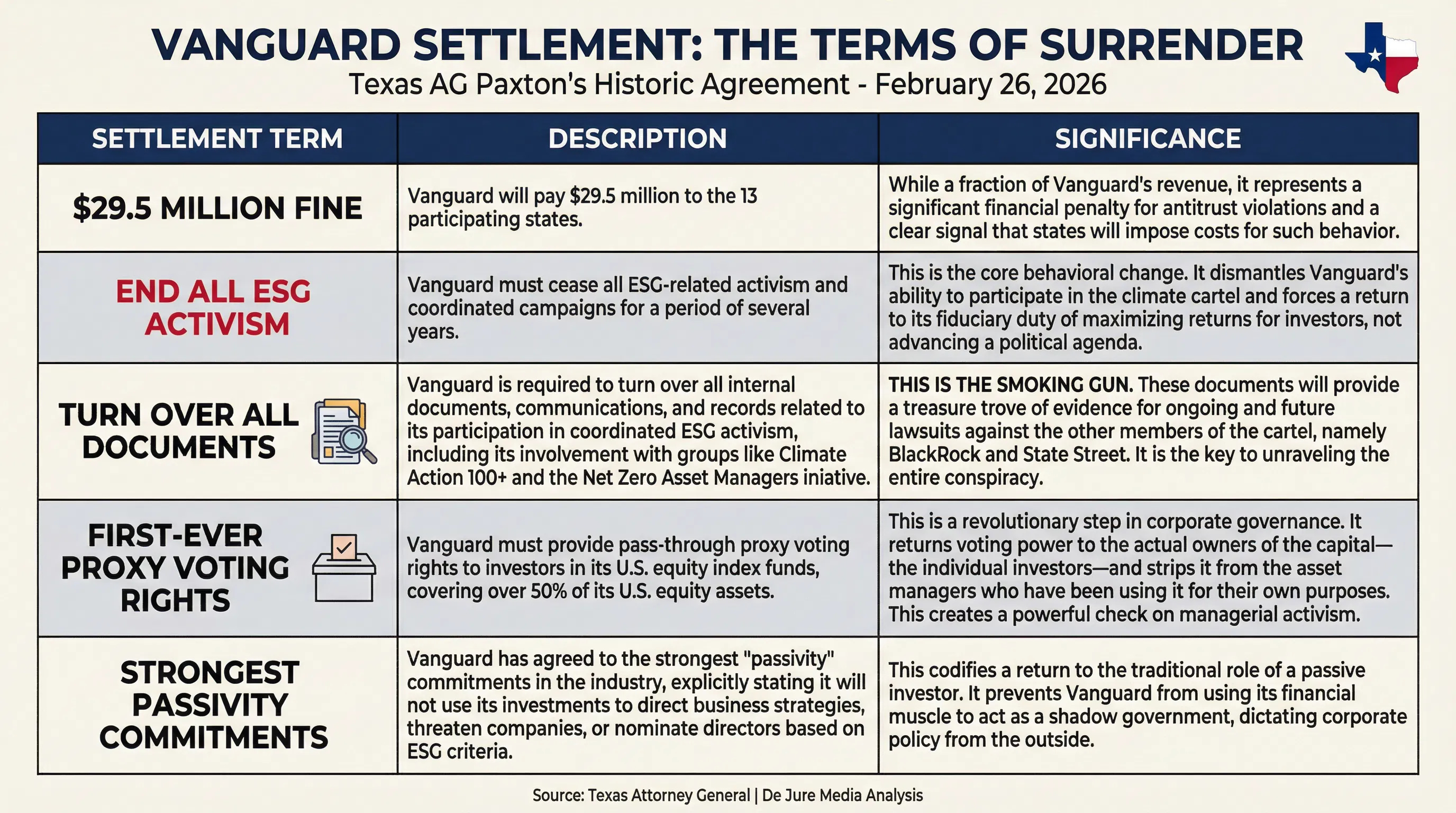
The agreement, announced on February 26, 2026, goes far beyond a simple monetary payment. It imposes a series of behavioral and structural changes that represent a complete capitulation by Vanguard.
The Cartel-Breaking Strategy
Texas AG Ken Paxton’s lawsuit was not merely a punitive action; it was a calculated, strategic move designed to break the climate cartel. By targeting all three major players simultaneously, the lawsuit created a classic prisoner’s dilemma. The first to break ranks and cooperate would receive the most favorable terms, leaving the others to face the full force of the law, now armed with the cooperating party’s evidence.
Vanguard, by choosing to settle, has become the state’s star witness. The document disclosure provision is the linchpin of this strategy. It is the smoking gun. It transforms the case from a battle of legal arguments into a matter of hard evidence. Vanguard’s internal emails, memos, and strategy documents will lay bare the extent of the coordination with BlackRock and State Street, providing a roadmap for prosecutors and a nightmare for the remaining defendants.
This is a cartel-breaking strategy in its purest form. Get one member to flip, use their testimony and evidence to convict the rest. The $29.5 million fine is secondary to the strategic value of the documents Vanguard is now legally compelled to produce.
The Constitutional Question: Sovereignty vs. Supranational Edicts
Beyond the mechanics of antitrust law, this case strikes at a far deeper issue we have consistently examined at De Jure Media: the erosion of state sovereignty by unelected, supranational powers. The ESG movement, at its core, is an attempt to create a shadow government, a parallel power structure that operates outside the constitutional framework. It seeks to achieve through economic coercion what it cannot achieve through democratic consent. By forcing companies to comply with its climate agenda, the ESG cartel effectively usurps the regulatory authority of the states, turning private corporations into instruments of a political ideology.
As we analyzed in “State Sovereignty vs. Corporate ‘Speech’,” the line between corporate influence and quasi-governmental authority has become dangerously blurred. The ESG cartel represents the apex of this trend, where financial power is not just influencing policy, but directly supplanting it. Texas’s lawsuit was a declaration that this usurpation would not stand. It was an affirmation of the principle of federalism, the idea that the states are not mere administrative subdivisions of the federal government, but sovereign entities with their own spheres of authority. The power to regulate energy, to manage natural resources, and to chart a course for economic development lies with the states, not with a handful of asset managers.
The Investor Empowerment Revolution
Perhaps the most overlooked, yet most revolutionary, aspect of the Vanguard settlement is the provision for pass-through proxy voting. This is the practical answer to the “They or We?” question. For decades, the proxy voting system has been a tool of managerial entrenchment. Asset managers, holding shares on behalf of millions of disconnected individuals, have accumulated immense voting power. They have used this power not to enhance shareholder value in the traditional sense, but to advance their own ideological and political objectives, often in direct opposition to the financial interests of their clients.
The Vanguard settlement shatters this model. By returning voting power to the individual investors, it creates a powerful new check on corporate and managerial power. It means that the actual owners of the capital will now have a direct say in how the companies they own are run. This is a paradigm shift in corporate governance, one that has the potential to ripple throughout the entire market. It is a move from a system of elite control to one of individual empowerment. It is a recognition that the money managed by Vanguard and its peers is not their own; it belongs to the millions of everyday Americans who have entrusted it to them. And with that ownership comes the right to a voice.
The Road Ahead: The Reckoning for BlackRock and State Street
With Vanguard’s surrender, all eyes now turn to BlackRock and State Street. They are the last remaining pillars of the climate cartel, and they are now facing a legal battle that has become infinitely more perilous. They are facing a plaintiff armed with their former co-conspirator’s entire playbook.
The documents that Vanguard will produce are likely to provide a detailed account of the coordination between the Big Three. They will show who said what, who agreed to what, and who was driving the strategy. For BlackRock CEO Larry Fink, who has been the public face of the ESG movement, this represents an existential threat.
The legal and political pressure on BlackRock and State Street will be immense. They can choose to fight on, risking a potentially devastating trial that could expose even more of their internal workings, or they can follow Vanguard’s lead and seek a settlement. But any settlement they reach will now be benchmarked against the terms of Vanguard’s surrender. The price of peace has gone up.
A Template for Constitutional Accountability
The Vanguard settlement is more than just a victory in a single antitrust case. It is a template. As we’ve argued in “Not a Rebellion, But a Remedy,” the most effective path to restoring the rule of law is through the courageous application of existing legal and constitutional frameworks. This settlement is a masterclass in that principle. It provides a roadmap for other states to follow in reasserting their sovereign authority over their own economic and energy futures. It demonstrates that the law, when wielded with conviction, remains a powerful tool for holding even the most powerful institutions accountable.
This victory is the latest chapter in the long-running struggle between the American spirit and the concentration of financial power on Wall Street.
It is a reminder that in the American system, the ultimate authority rests not with the powerful, but with the people and their elected representatives. The climate cartel, for all its wealth and influence, has been dealt a decisive blow. The reckoning is here. And it began in Texas.
Finally, We the People, make some headway. Now let’s see how quickly Vanguard relinquishes the docs.